
Ember One
Open-source Bitcoin mining hash board reference design
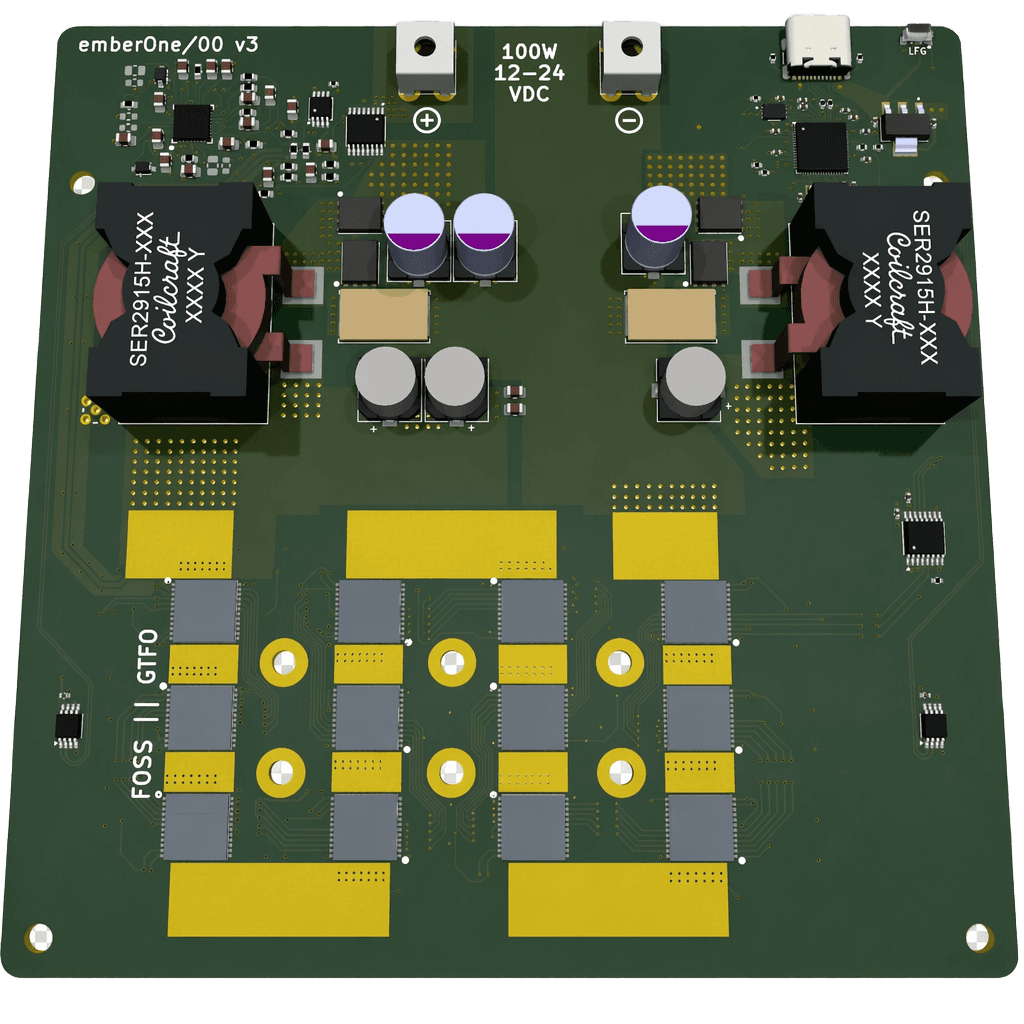
Ember One is a fully open-source hardware reference design for a Bitcoin mining hash board. It provides the foundational blueprint that individual miners, researchers, and companies can build upon — breaking the dependency on proprietary designs.
Why This Is a Core Grant
The 256 Foundation identified the absence of any open-source Bitcoin mining hash board design as a critical gap in the ecosystem. Without an open hardware foundation, every other layer of the mining stack remains dependent on closed, proprietary hardware. Ember One fills this gap by creating a reference design that is freely available under an open hardware license.
Why It's Necessary
A single hardware company has maintained near-total control over Bitcoin mining hash board designs for years, blocking innovation and preventing the development of a competitive, diverse hardware ecosystem. Ember One disrupts this by providing a fully documented, CERN-OHL-S-2.0 licensed reference design that anyone can manufacture, modify, or build upon — democratizing access to mining hardware at the most fundamental level.
Why Not Just Use Bitaxe?
The Bitaxe — created by Skot, who is also a core contributor on Ember One — is the first open-source Bitcoin ASIC miner and a landmark achievement. But it was designed to teach one-chip mining, not to model how a production Bitcoin miner is built. Ember One exists because those are two fundamentally different problems.
Hash boards and control boards are separate
In every commercial Bitcoin miner, the hash board — the PCB packed with ASIC chips — is a distinct component from the control board that manages it. The Bitaxe integrates both onto a single board, which is perfect for learning but not representative of how real miners are designed, repaired, or upgraded. Ember One is a standalone hash board, just like those in production hardware.
Real miners have hundreds of chips in series
Most Bitaxe models run a single ASIC chip. Production Bitcoin miners run dozens to hundreds of chips in series across one or more hash boards. Learning to reliably chain chips, balance power, and handle failures at that scale requires a different reference design entirely — and that's exactly what Ember One provides.
Hash boards are the component that changes
When a new ASIC generation arrives, it's the hash board that gets swapped out. Hash boards are also the part most likely to fail, be repaired, or be upgraded independently. If you're building a miner with a long service life, you need to know how to design, source, and maintain a hash board — not just interface with a single chip.
A true reference design includes all the real-world components
Ember One is designed with the full complement of hardware you'd find on a production hash board: wide voltage input range, USB-C data interface, integrated temperature sensors, and a standard form factor. It's the reference a hardware engineer actually needs — not a simplified teaching tool, but a production-grade open blueprint.
Technical Details
Ember One 00 is built around the Bitmain BM1362 ASIC, with an open PCB layout, full bill of materials, and firmware interface specification published under the CERN-OHL-S-2.0 open hardware license. The board draws approximately 100W at 12–24V DC input, communicates via USB-C, and integrates onboard temperature sensors for thermal management. Its standardized 125×125mm form factor and 6-month release cadence make it a stable, iterative foundation for the open mining stack. Natively compatible with Libre Board and Mujina firmware.
Key Specifications
Features & Compatibility
Current Hardware
- →Bitmain BM1362 ASIC
- →USB-C data interface
- →Integrated temperature sensors
- →PiAxe/Pyminer firmware (initial)
Upcoming ASIC Support
- →Intel BZM2
- →Auradine
- →Proto Mining
Stack Integration
- →Mujina firmware (native)
- →Libre Board control board
- →Standard mining control interfaces
- →Open PCB design files
About the Ember One Hashboard category
Open-source Bitcoin mining hashboard reference design. Supports various ASIC chips. ~100W, 12–24VDC input, USB-C, 125mm × 125mm standard form factor. Fork it, build it, hack it. Part of the 256 Foundation open mining sta…
Waterblock stl?
Hey is there a waterblock stl file for the emberone ? Because I do plan on building one and would love to have a waterblock to cool it :slight_smile:
Auradine support?
Any plans in the near term to support auradine treasure asic?
Update README with ASIC chip details
skot · 12mo ago
Merge pull request #42 from benjamin-wilson/master
skot · 15mo ago
Merge pull request #41 from cyberjunky/patch-1
skot · 15mo ago
fixed wrong part number
Ben · 16mo ago
missed a few
Ben · 16mo ago
Added Mfg to BOM
Ben · 16mo ago

Skot
@skot9000
Core Contributor
Electrical engineer with years of embedded systems experience, Skot instigated the Bitaxe project — the first open-source Bitcoin ASIC miner — and brings that same hands-on hardware conviction to Ember One. He is one of the most prolific forces in open-source Bitcoin mining hardware.
Econoalchemist
@econoalchemist
Project Manager
Bitcoin educator, technical writer, and co-host of the POD256 podcast. Co-founder of the 256 Foundation and project manager across all four pillar grants.